
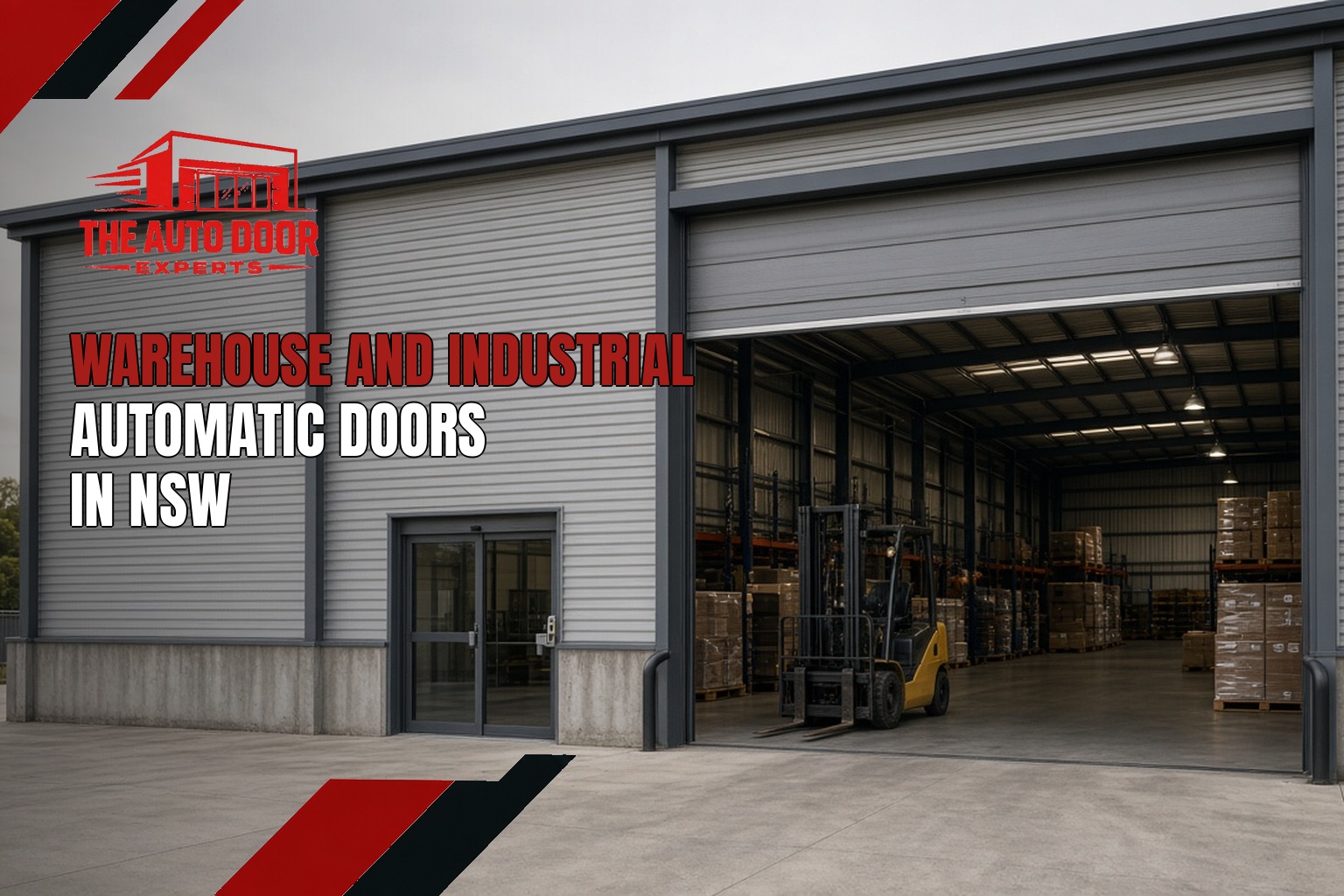
The Warehouse automatic doors on a forklift site
A warehouse in Smithfield had been through three repairs in six months. The door was not old. It had been put in during a fit-out by a builder who used the same slider he had just fitted on a retail strip. By the time we saw it, the bottom track was full of fine dust, a forklift had clipped the leading stile twice, and the sensor was reading the high-vis vests of everyone who walked past the opening, so the door never quite shut.
That job is the reason this article exists. We already have a general industry page. This one stays on warehouses and light industrial units, because the door that works on a pharmacy will not live on a loading path.
What is different about a warehouse entrance
Four things, every time.
Dust. Cardboard, timber, concrete cutting, powder coat. It sits on the sensor lens and it sits in the track. A door that is cleaned monthly in a shop needs a look every week in a busy store. If nobody is going to do that, the specification has to tolerate dirt better: covered rollers, a track that can be blown out, sensors mounted where a broom does not hit them.
Impact. Trolleys and pallet jacks find the leaf. The question is not whether it will be hit. It is whether a hit bends the door or only scuffs it. A heavier bottom rail and a proper crash bar cost less than a new leaf.
Wind. A big opening on the western side of a shed in Western Sydney will catch the afternoon change. Lightweight leaves twist. A door that is not commissioned for that wind will hunt, alarm, or refuse to close. This is a commissioning problem as much as a product problem.
Hours. Warehouses start early. A door that fails at 5.30am stops the inbound truck. The repair number on the header has to be the night number, not the builder’s mobile from two years ago.
Slider, swing, or something else
For a person door beside a roller shutter, a single automatic swing door is often the right tool. People in and out, pallet access stays on the shutter. The swing door needs a closer that matches the leaf, and a lobby or a side screen if the wind is serious.
For a person door that is also the main in-and-out for pickers with trolleys, a bi-parting slider is kinder. It keeps the opening clear and it does not sweep a trolley. It needs width. On a narrow personnel door, telescopic leaves can give a wider clear opening without a wider structural hole. That is a design conversation with the builder, not a swap you do after the steel is in.
We do not put a retail header on a door that forklifts pass. If vehicles use the opening, that opening wants an industrial door, a fast roller or a proper loading door, with a separate pedestrian door beside it. Mixing the two is how people get hit and how motors die.
Sensors that do not false-trip all day
A warehouse sensor has to see a person and ignore a pallet that is sitting two metres inside the door. Microwave sensors set too wide will hold the door open every time a forklift crosses the aisle. Infrared presence sensors set too low will hold it for a pallet. The fix is aim and zoning, done with the site running, not on a quiet Saturday with no stock movement.
If the door faces west, specify a sensor that can cope with low sun. We have replaced more than one unit that worked all morning and failed at 3pm because the lens was washed out. The staff description is always the same: “it only plays up in the afternoon”. Believe them.
What to put in the brief
If you are the tenant or the project manager, these lines save a variation later.
· Pedestrian door only, or shared with trolleys. Not a vehicle door.
· Opening width clear, not structural width. Say the number you need for two people and a pallet jack.
· Wind exposure: sheltered, or west-facing, or on a ridge.
· Dust level: clean store, or cutting and packaging on the same floor.
· Hours of use, and whether a failure at 5.30am stops the shift.
· Locking: electric lock on the auto door, or a separate manual lock after hours.
· Who holds the service contract after handover.
The last line is the one that gets missed. A door installed by the builder and never serviced is a door we meet at month eight, full of dust, out of adjustment, and already blamed on “the auto door people” who have never seen it.
A maintenance rhythm that matches the building
On a clean warehouse, twice a year is the minimum we are comfortable with: track, rollers, belt or arm, sensor aim, safety test, lock. On a dusty site, quarterly. This is not a sales script. A roller that has been grinding for a month costs more than the visit that would have cleaned it.
Keep a one-line log on the wall: date, what was done, who attended. When the facility manager changes, that sheet is the history. Without it, every new contractor starts from zero and the door gets “repaired” in three different ways.
If you already have the wrong door
You do not always have to rip it out this month. A covered track, a sensor re-aim, a heavier roller set and a proper service interval will get a marginal door through a lease. If the header is a light retail unit and the cycle count is already high, price the industrial operator now and pick the quiet week. Waiting for the motor to fail on a Monday inbound is the expensive version of the same decision.
We work across Sydney and wider NSW on these doors. If you have a shed door that will not stay shut, or a fit-out that is about to copy a shopfront detail onto a warehouse, send the drawing or a photo of the opening. Sales on 1300 829 998, or sales@theautodoorexperts.com.au.
A morning on a Western Sydney shed
The useful site visit is early, while the inbound is running. We stand clear of the forklift path and watch ten minutes of real traffic. Who uses the pedestrian door. Whether pickers cut through with a pallet jack. Whether the door closes between people or stands open from 6am to 9am. A door that stands open all morning is not saving labour. It is an uncontrolled opening, and the sensor is probably zoned for the aisle rather than the person.
Smithfield, Wetherill Park, Eastern Creek, Mascot, Alexandria: the sheds look different and the door fault is often the same. Dust in the track, a sensor aimed at the high-vis line, a retail operator asked to cycle all day. Newcastle and the Central Coast throw in salt air on sites near the water. The header cover matters more there. If it does not seal, the board is on borrowed time.
Safety without the lecture
A pedestrian door beside a vehicle door needs a clear line between the two. Paint on the slab fades. A bollard or a rail does not. We are not the traffic consultant, but we will not commission a person door that opens straight into a forklift turn if we can see the conflict from the threshold. Say it in the brief and the steel goes in once.
After hours, decide if the auto door should lock or if the building is secured on the roller shutter only. An auto door left on free access because “the shutter is down” is fine until someone leaves the shutter up. Write the night position on the service sheet.
Cost, said plainly
A personnel slider for a clean store is a different number from a door that has to live with dust, wind and the occasional trolley. We will not put a fake range in this article. Openings, leaf weight and wind change it. What we will say is that the cheap header is the expensive one if it is the wrong tool. Price the industrial option against two years of call-outs, not against the shopfront quote the builder already has.
Handover, when the builder leaves
The week the builder finishes is the week the door is most likely to be wrong and nobody owns it. Keys for the mode switch go missing. The sensor is still aimed at the site shed that has been removed. The number on the header is the apprentice’s mobile.
Ask for a commissioning walk with the warehouse supervisor present, not only the site manager. Cycle the door while a pallet jack goes past. Confirm the night lock. Put the service number on the header if we are the ones who will attend. If another company installed it, the number on the header should be theirs, and it should be a number that answers.
That handover is dull. It is also the difference between a door that starts its life in adjustment and a door we meet six months later, already blamed on the operator. Smithfield and Eastern Creek fit-outs are where we see this most. The drawing was fine. The last week on site was not.