
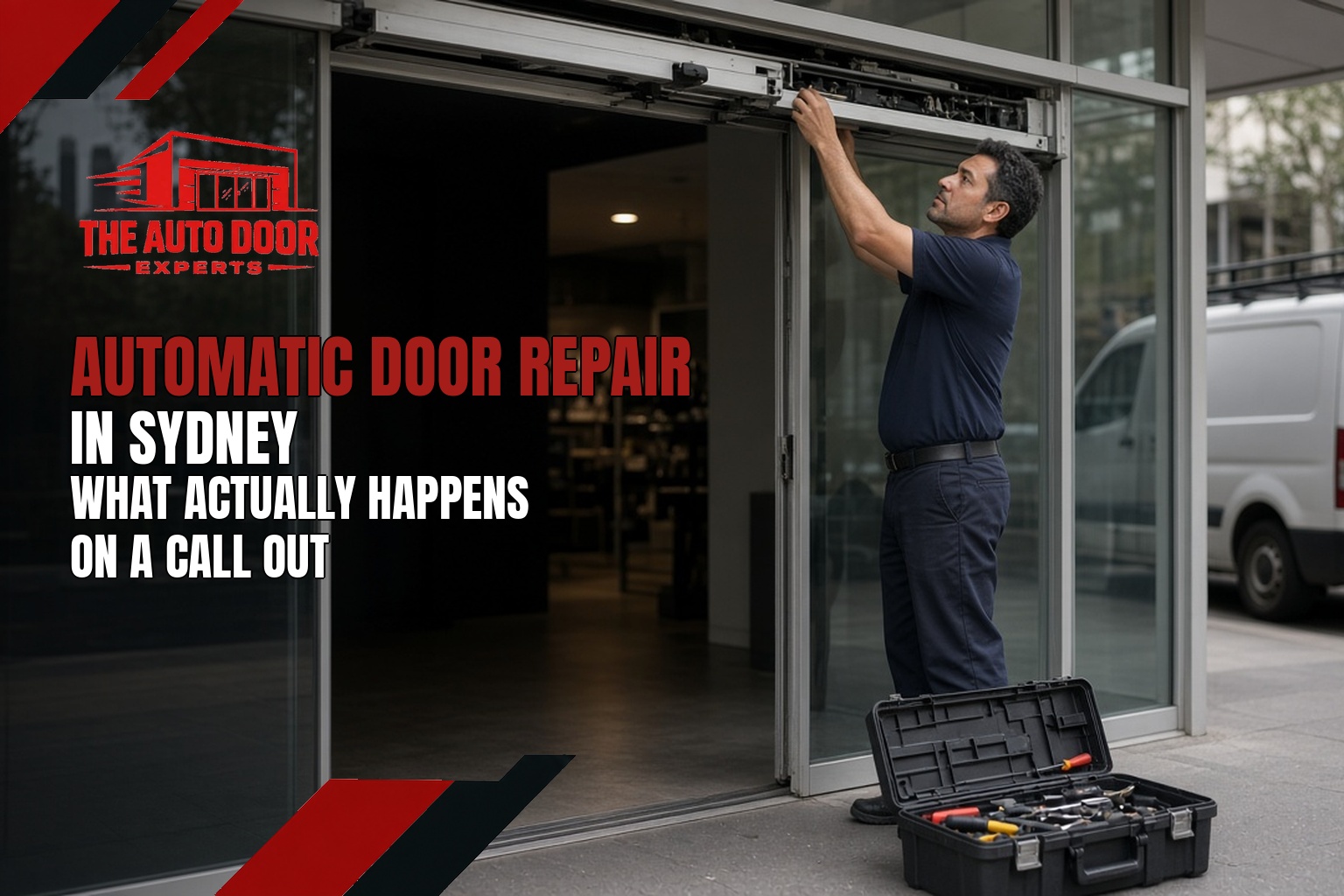
The door that would not open at 7.40am
A cafe manager in Marrickville rang just after the breakfast rush should have started. The sliding door at the street had opened for the first few customers, then stopped halfway and stayed there. Staff were holding it by hand. The coffee machine was on. People were walking past.
That is the usual shape of an automatic door repair Sydney. It is rarely a quiet Tuesday with time to plan. It is a door that has picked the busiest hour of the week. The job of the first phone call is not to diagnose the whole system. It is to keep people moving, keep the entrance safe, and get a technician to the right door with the right parts already in mind.
This piece is the practical version of that morning. It is not a list of warning signs. We have already written that. It is what happens between the phone call and the door working again.
What to do in the first ten minutes
Most commercial operators have a way to take the door off automatic. On a lot of sliding doors it is a key switch or a small mode button on the header: auto, hold open, exit only, off. Swing doors often have a similar switch near the lock stile or inside the plant room. If you know where it is, use it. Hold the door fully open if the footpath is busy, or close it and use a side door if you have one.
If you do not know the switch, do not keep waving at the sensor. That rarely helps, and on a door that is hunting it can make the leaf slam. Put a person on the door or wedge it in a safe open position if the leaf is light enough to hold. Then ring. Tell us three things: the suburb, whether it is a slider or a swing door, and what it is doing right now. “Stuck half open since 7.40, two customers held it, no bang, just stopped” is more useful than “the door is broken”.
A photo of the header and a photo of any sticker on the operator saves a second trip. Brand names on Sydney doors are often Dorma, record, GEZE, Ditec, Label or a no-name header that was fitted during a fit-out. We do not need the model number to leave the workshop. We do need it before we promise a same-day part.
What the technician is actually looking at
On a first visit the work is usually in this order.
Power first. A door that died at the same moment as the shop lights is a supply problem, not a door problem. We still check it, because a loose neutral in the header can look exactly like a dead motor. Then the mode switch, then the safety sensors, then the belt or the arm, then the controller.
Sensors cause more “repairs” than motors. A safety beam blocked by a new A-frame, a presence sensor blinded by afternoon sun on a west-facing shopfront in Parramatta, a lens filmed with cooking grease in a food tenancy. The door is doing what it was told. It thinks someone is standing in the way. Cleaning the lens is sometimes the whole job. Realigning a beam that a signwriter has nudged is sometimes the whole job. Replacing a cracked sensor is a different job, and it is obvious once the cover is off: the unit is yellowed, cracked, or the cable has been pulled.
Mechanical faults are louder. A slider that grinds has usually lost a roller or picked up grit in the track. A swing door that drops at the end of the close often has a worn arm or a closer spring that no longer matches the leaf weight. We see this on older office doors in North Sydney and on retail doors that have been re-glazed with heavier glass and never re-commissioned.
Controller faults are the quiet ones. The door opens, pauses too long, then creeps. Or it opens only from the inside. Or it works until the air conditioning starts and the voltage dips. Those need the cover off and a bit of time. They are also the jobs that should not be “fixed” by turning the safety down. If a door only works because the sensor has been desensitised, it is not repaired.
How long a normal repair takes
A sensor clean, a beam realignment or a mode-switch fault is often under an hour on site, plus travel. A roller set or a belt on a common slider is often the same visit if the part is on the van. A controller, a motor or a non-standard arm can be a return visit. We would rather say that on the phone than pretend every door is a one-hour job.
Emergency automatic door repair is the same work, done sooner. The difference is the time of day and whether the entrance is the only way in. A shopping-centre tenancy that can trade through a side mall door is not the same call as a medical centre on Victoria Road with one entrance and a full waiting room. Say which one you are. It changes the order we run the board.
What makes a repair turn into a replacement
We will say it on site if it is true. A header that has been full of water, a track that is twisted, a leaf that has been hit by a trolley and no longer sits square: those are not sensor jobs. Patching them keeps the door moving for a month and then the same fault comes back. On a tenancy with a short lease that can still be the right call. On a building you own, it usually is not.
The line we use with facility managers is simple. If the same door has had three call-outs in six months and the parts are wearing in different places, the operator is at the end of its life or it was the wrong operator for the traffic. A warehouse door fitted with a retail header is the classic version. That is a different article. For a normal shopfront, three repeat faults is the point where we price a replacement beside the next repair, not instead of a conversation.
After the door is moving again
A repaired door should be walked. Open from outside, open from inside, stand in the doorway and confirm it will not close on you, then check the lock if it has one. If we have changed a sensor or a controller, we re-check the speeds. AS5007 is the standard that sits behind that check. You do not need to know the clause numbers. You do need the door to hesitate when someone is in the way, and to lock properly after hours.
Ask for the fault in writing in a sentence, not a code. “Bottom safety beam was blocked by the new menu board; realigned and tested” is something the next manager can use. “Serviced door” is not.
Suburbs we are in most weeks
Repair work clusters. Inner west shopfronts, Parramatta and the Hills, North Sydney and Chatswood offices, airport and Mascot industrial, Liverpool and Campbelltown retail. If you are outside that and the door is the only entrance, still ring. Travel is a scheduling question, not a no.
If the door is already off and you are trading, send the photo of the header before we leave the workshop. That single picture is the difference between a first visit that finishes the job and a first visit that only confirms the part.
A repair we would rather not repeat
Last winter a retail manager in Bankstown lived with a door that opened, paused, and then crept shut for nearly three weeks. Customers got used to it. Staff stopped mentioning it. When the motor finally gave up on a Saturday, the tenancy had no side door and the centre would not let them trade with a propped leaf. The repair that would have been a belt and a sensor clean in week one became a controller and a lost Saturday.
The pattern is familiar across Sydney. The door is “mostly fine”, so it stays on the list under the air conditioning guy and the fridge seal. Automatic doors do not fade politely. They work, then they hunt, then they stop in the position they happened to be in. If that position is half open on a wet footpath, you also own the slip risk until someone arrives.
Write down the time it started and whether it followed a blackout, a storm, or a shopfitter. Those three details steer the first hour on site. A door that died in a blackout wants the supply checked before anyone prices a motor. A door that died after a signwriter was on a ladder wants the sensor checked before anyone prices a controller.
Parts, and why we will not guess on the phone
Operators in Sydney are a mix of current commercial brands and headers that came in with a fit-out and were never badged clearly. Some take a common belt. Some take an arm that is still on a van. A few need a board that is a two-day order. Promising “we’ll have it going this afternoon” before we have seen the header is how second visits get born.
If the door is under a builder’s warranty, say so. We can still make it safe. The invoice may sit with them. If the lease says the landlord owns the entrance, say that too. Neither point changes the fault. Both change who signs the sheet.
What good looks like when we leave
The door opens from the street and from inside. It sees a person in the threshold and waits. The lock engages in the night position. The mode switch is labelled, even if the label is a piece of tape and a pen. The manager has one sentence on what failed. If we could not finish, the door is left in a stated mode — hold open, or off and manually usable — not in a half state.
That is the whole promise of an automatic door repair visit. Not a new entrance. A door that does the job it was already paid to do.