
Objective
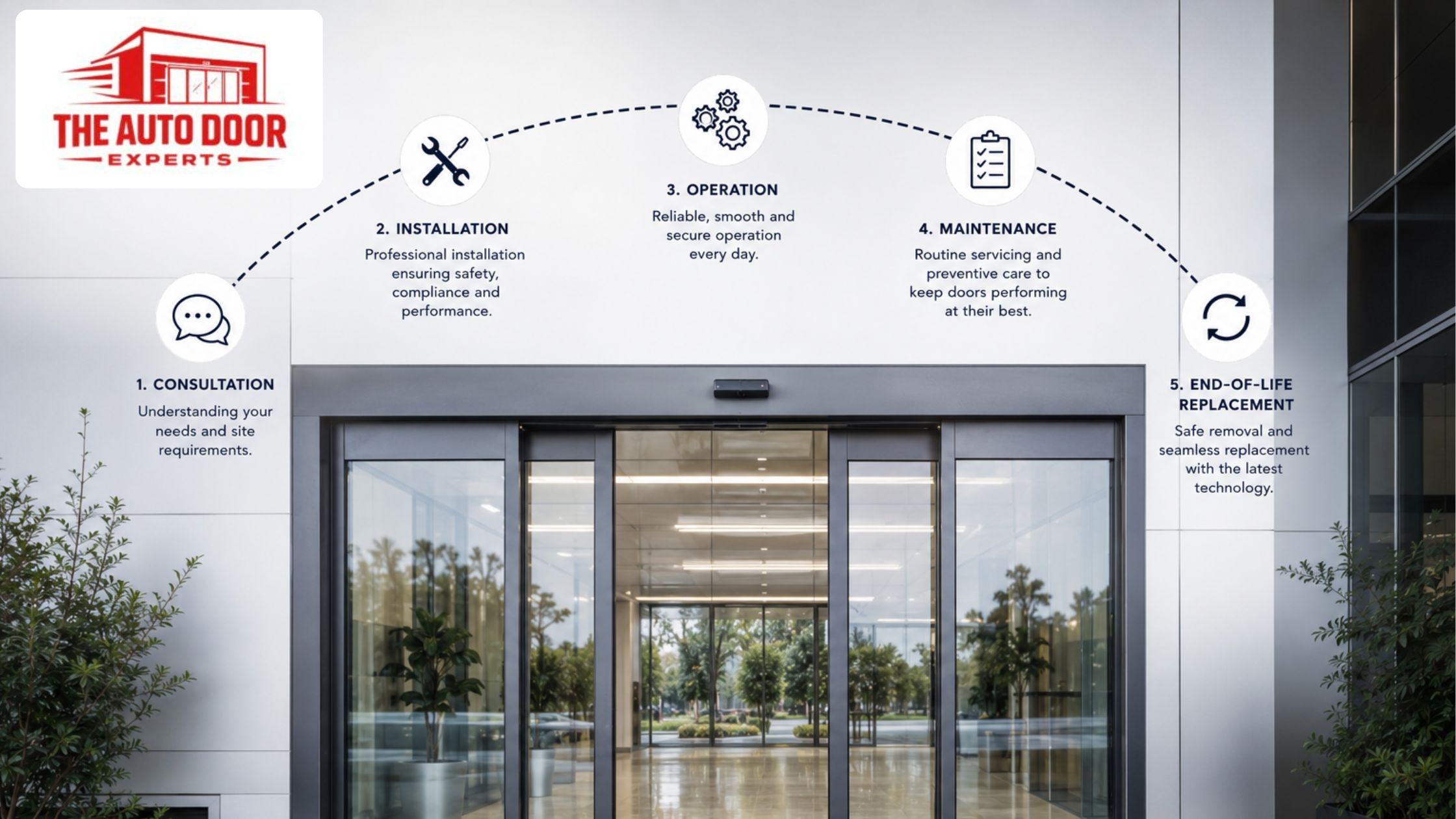
This blog walks business owners, facility managers, and property developers through every stage of a commercial automatic door’s life, from the day it is installed to the day it needs replacing. The goal is to help you make smarter decisions about maintenance, budgeting, and timely upgrades so your doors never become a liability.
Key Takeaways
- Most commercial automatic doors last between 10 and 20 years with proper care
- Regular servicing is the single biggest factor in extending door lifespan
- Ignoring early warning signs often leads to costly emergency repairs or full replacements
- A structured maintenance checklist keeps small issues from snowballing
- Knowing when to replace rather than repair saves money in the long run
Table of Contents
- Why the Lifecycle of Your Automatic Door Matters
- Stage 1: Project Planning and Site Assessment
- Stage 2: The Early Years (0 to 5 Years)
- Stage 3: Mid-Life Performance (5 to 12 Years)
- Commercial Automatic Door Maintenance Checklist
- Signs an Automatic Door Needs Replacement
- How Long Do Commercial Automatic Doors Last?
- Stage 4: End-of-Life and Replacement
- Conclusion and CTA
- FAQs
1. Why the Lifecycle of Your Automatic Door Matters
A commercial automatic door is not a set-and-forget fixture. It works hard every single day, handling hundreds or even thousands of open-and-close cycles in busy retail stores, hospitals, offices, and industrial facilities. Each cycle adds wear to sensors, drive belts, motors, and track systems. When that wear is managed well, a door delivers safe, efficient access for well over a decade. When it is ignored, problems pile up fast.
Understanding the full lifecycle helps you plan maintenance budgets, avoid unplanned downtime, and know exactly when replacement makes more financial sense than repair. This guide breaks it down stage by stage.
2. Stage 1: Project Planning and Site Assessment
Getting the lifecycle right starts before the door ever moves. A proper automatic door installation involves far more than fitting a sliding panel into a frame. The site needs to be assessed for traffic volume, environmental exposure such as dust, humidity and wind, accessibility requirements, and the relevant Australian standards for powered pedestrian doors, including AS 5007 and AS 1428 where applicable.
Choosing the right door type matters enormously here. Sliding doors suit high-traffic entrances. Swing operators work well for narrower openings or heritage buildings. Bi-folding doors handle spaces where a slide or swing would be impractical. Each type comes with different maintenance demands and expected lifespans.
The quality of components at installation also determines how long commercial automatic doors last. Budget hardware might look fine on day one, but premium motors, sensors, and control boards from reputable manufacturers will outlast cheaper alternatives by years. Cutting corners at installation is one of the most common reasons doors fail prematurely.
3. Stage 2: The Early Years (0 to 5 Years)
The first five years are generally the smoothest. A properly installed door requires minimal intervention beyond routine servicing. During this period, the key tasks are keeping the tracks clean, checking sensor alignment every few months, and lubricating moving parts on schedule.
Many operators assume a new door needs no attention. That mindset leads to small issues going unnoticed, such as slight sensor drift, minor debris buildup in tracks, or loose fasteners that vibrate free over time—catching these early costs very little. Letting them compound into a motor failure or a damaged panel costs significantly more.
Professional service intervals should follow the manufacturer’s guidance and the relevant Australian standard for powered pedestrian doors. In many commercial settings, this means scheduled inspections several times a year, with more frequent checks for high-traffic, harsh, or critical-access entrances.
4. Stage 3: Mid-Life Performance (5 to 12 Years)
This is where doors begin to show their character. A well-maintained door in year seven or eight will still operate nearly as smoothly as it did on day one. A neglected one will start showing frustrating symptoms such as sluggish opening speeds, sensor hesitation, grinding noises, or intermittent failures.
Servicing frequency should increase during this stage. Twice-yearly professional checks become worthwhile, and operators should stay alert to any changes in behaviour between visits. Following a scheduled automatic door maintenance plan during these mid-life years is the single most effective way to catch worn components before they cause unplanned downtime. Drive belts and batteries in backup systems often need replacing somewhere in this window, and that is completely normal.
This is also the stage where you start weighing up repair costs against the broader picture. If a single repair costs 30 to 40 percent of a new unit, it is worth asking how many more repairs are likely to follow.
5. Commercial Automatic Door Maintenance Checklist
Staying on top of maintenance is what separates a door that lasts 20 years from one that gives up at 10. Here is a practical commercial automatic door maintenance checklist to work through regularly:
Monthly Checks
- Wipe down sensors and check for obstructions
- Inspect tracks and remove any debris
- Listen for unusual sounds during operation
- Test emergency manual release function
Every 3 to 6 Months
- Lubricate drive belts, rollers, and hinges with appropriate products
- Check all fasteners and tighten where needed
- Test sensor detection range and response time
- Inspect door seals and weather stripping
Annual Professional Service
- Full motor and drive system inspection
- Control board diagnostics
- Safety force and opening speed calibration
- Full compliance check against current Australian standards
- Review of battery backup system (where applicable)
Skipping items on this checklist does not save money. It defers costs and compounds them.
6. Signs an Automatic Door Needs Replacement
Repairs make sense when a door has life left in it. But there are signs an automatic door needs replacement that should not be ignored:
- The door requires repairs more than twice a year
- Replacement parts are discontinued or difficult to source
- The motor struggles to complete full open or close cycles
- Safety sensors fail regularly despite recalibration
- The door no longer meets current Australian safety or accessibility standards
- Structural components such as the frame or track system are corroded or warped
- Energy efficiency has dropped noticeably due to poor sealing or slow operation
If you are seeing three or more of these issues at the same time, replacement is almost certainly the smarter financial call.
7. How Long Do Commercial Automatic Doors Last?
This is one of the most common questions facility managers ask, and the honest answer is that it depends. On average, how long do commercial automatic doors last comes down to three factors: installation quality, traffic volume, and how consistently the door is serviced.
In low-to-medium traffic environments with regular maintenance, 15 to 20 years is realistic. In high-traffic settings like hospitals or busy retail centres, 10 to 15 years is more typical. Doors in harsh environments such as coastal properties, construction zones, or industrial sites may reach end-of-life earlier due to accelerated wear from salt air, dust, or heavy use.
No door lasts forever, but proper care stretches that timeline significantly.
8. Stage 4: End-of-Life and Replacement
When replacement day arrives, it is an opportunity as much as an obligation. New automatic door systems offer better energy efficiency, smarter access control integration, improved safety sensors, and lower ongoing maintenance costs than models from 10 or 15 years ago.
The replacement process should involve the same level of planning as the original installation. Reassess your traffic needs, check for any changes to compliance requirements, and consider future-proofing with systems that support remote diagnostics or building management integration.
Responsible disposal of the old unit matters too. Many components, including motors, control boards, and aluminium frames, can be recycled. A reputable installer will advise on environmentally responsible removal.
Conclusion
Your commercial automatic door is a long-term investment, and like any investment, it rewards attention. From the moment of installation through routine servicing, mid-life repairs, and eventual replacement, every stage shapes how reliable and cost-effective that door is for your business.
The teams at The Auto Door Experts understand the full picture. If you are unsure what to expect from a professional service visit, read our detailed guide on what a scheduled automatic door service includes so you know exactly what your technician should be checking at every stage.
Contact The Auto Door Experts today to book a site assessment or maintenance inspection. Let us keep your doors working for you, not against you.
FAQs
How long do commercial automatic doors last on average?
Most last between 10 and 20 years depending on traffic volume, installation quality, and how regularly they are serviced.
How often should a commercial automatic door be serviced?
Commercial automatic doors should be serviced according to the manufacturer’s instructions and the relevant Australian standard. Many powered pedestrian doors need scheduled inspections several times a year, and high-traffic entrances may need more frequent servicing.
What are the most common signs an automatic door needs replacement?
Frequent breakdowns, unavailable parts, failing safety sensors, and non-compliance with current Australian standards are the clearest indicators.
Can I extend the life of my automatic door?
Yes. Sticking to a regular commercial automatic door maintenance checklist and booking professional services on schedule significantly extends lifespan.
Is it worth repairing an older automatic door or should I replace it?
If repair costs are approaching 40 percent of replacement cost, or if the door needs repairs multiple times a year, replacement is usually the better financial decision.
What happens to the old door when it is replaced?
A good installer will manage responsible disposal. Many components, including motors, frames, and control boards, can be recycled or repurposed.