
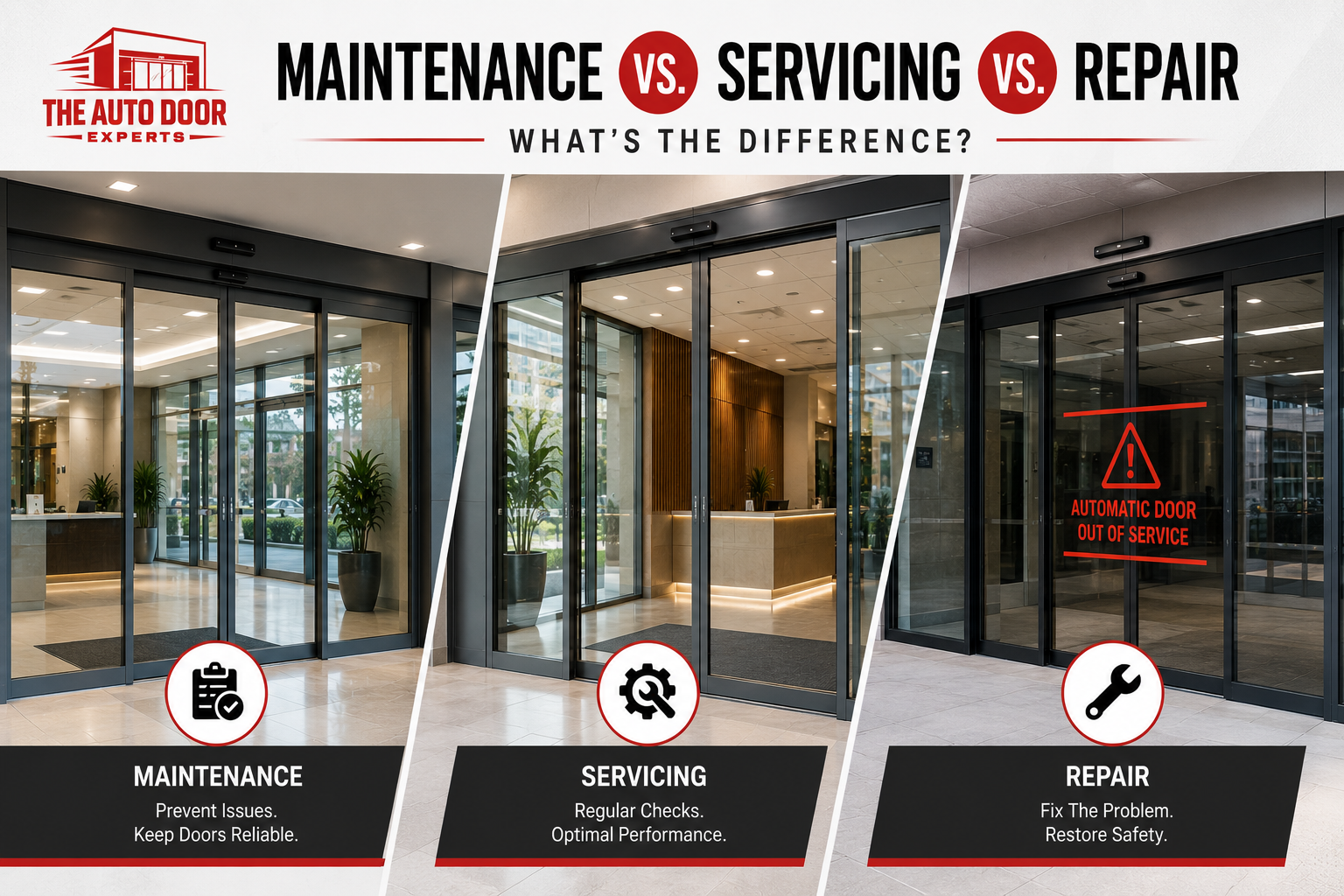
Introduction
We had a client call us in a bit of a panic a few months back — their main entrance had stopped working entirely, right in the middle of a busy trading day. When we got there, it turned out to be a worn roller that had been making a faint clicking noise for weeks. Nobody had mentioned it because nobody knew it mattered. That one call ended up costing far more, and causing far more disruption, than it would have if it had been caught during a routine check. It’s a pattern we see constantly, and it usually comes down to businesses not realising that maintenance, servicing, and repair are three genuinely different things — not three words for the same visit.
Here’s how they actually differ, and why the distinction is worth understanding before you’re the one calling us mid-breakdown.
What Is Automatic Door Maintenance?
Automatic door maintenance is preventative work — scheduled inspection, cleaning, and lubrication designed to catch small issues, like a slightly worn roller or a dusty sensor, before they turn into a bigger problem. This is the cheapest and most predictable of the three, because it’s planned in advance rather than reactive.
Think of it as the equivalent of an oil change: nothing is broken yet, but skipping it consistently is what leads to something breaking later.
What Is Automatic Door Servicing?
Automatic door servicing goes a step further than basic maintenance. A proper service includes testing the safety sensors, checking force settings and calibration, and confirming the door still meets AS5007 compliance requirements. This is typically carried out under a periodic maintenance contract — quarterly, bi-annually, or annually, depending on how heavily the door is used.
In short: maintenance keeps the door clean and lubricated; servicing confirms it’s still safe, calibrated, and compliant.
What Is Automatic Door Repair?
Automatic door repair is reactive — fixing a fault that’s already happened. This could be anything from a dead motor to a broken belt or a sensor that’s stopped responding. Repairs cost more than maintenance or servicing for one simple reason: they’re unplanned, and often urgent, especially when the fault affects a main entrance during trading hours.
This is also where emergency automatic door repair and commercial door repair come in — the same underlying work, just performed under time pressure because the door has already failed.
What Is Automatic Door Replacement?
Automatic door replacement becomes the right call when a door’s operator, frame, or glazing has reached genuine end-of-life, or when ongoing repairs are costing more, over time, than a full replacement would. This is usually the last stage in the lifecycle, not the first response to a fault.
Maintenance vs. Servicing vs. Repair: The Actual Difference
Maintenance is preventative, servicing confirms compliance and safety, repair fixes something that’s already broken — and the businesses that invest in the first two almost always spend less on the third.
| Maintenance | Servicing | Repair | |
| Nature | Preventative | Preventative + compliance check | Reactive |
| Timing | Scheduled | Scheduled (periodic contract) | Unplanned, often urgent |
| Typical cost | Lowest, predictable | Moderate, predictable | Highest, unpredictable |
| Goal | Catch small issues early | Confirm safety & AS5007 compliance | Fix an existing fault |
Why This Distinction Actually Matters for Your Business
The pattern is consistent across every industry we service: businesses on a regular maintenance and servicing plan have noticeably fewer emergency repair call-outs than businesses without one. It’s not a coincidence — most repair callouts we attend trace back to a small warning sign that had been building for weeks, sometimes months, before it became a full breakdown.
If your automatic door hasn’t had a proper service in the last 12 months, that’s the thing worth booking now — before it turns into the kind of call that comes in mid-trading-day.
Frequently Asked Questions
How often should an automatic door be serviced? Most commercial automatic doors should be serviced at least once or twice a year, though high-traffic sites like supermarkets or hospitals may need quarterly servicing to stay ahead of wear and compliance requirements.
Is maintenance the same as a warranty? No. A warranty covers manufacturing defects for a set period; maintenance is an ongoing service you arrange separately to keep the door running safely and compliantly over its full lifespan.
Can I skip servicing if the door seems to be working fine? It’s not recommended. Many early warning signs — a slightly slower door, a faint noise, a sensor that hesitates — aren’t obvious to someone using the door daily, but they’re exactly what a proper service is designed to catch.
How do I know if I need a repair or a full replacement? As a general rule, if the operator, frame, or glazing is ageing and repairs are becoming frequent, a replacement often works out more cost-effective than repeated reactive fixes. A site assessment can confirm which makes more sense for your specific door.
Book a Maintenance Check Before It Becomes an Emergency
If your automatic door hasn’t been serviced in the last year, or you’re not sure when it was last checked, that’s the easiest problem to solve on your terms rather than during a breakdown.
The Auto Door Experts offer maintenance plans, scheduled servicing, and 24/7 emergency repair across NSW. Call 1300 829 998 or request a maintenance quote.