
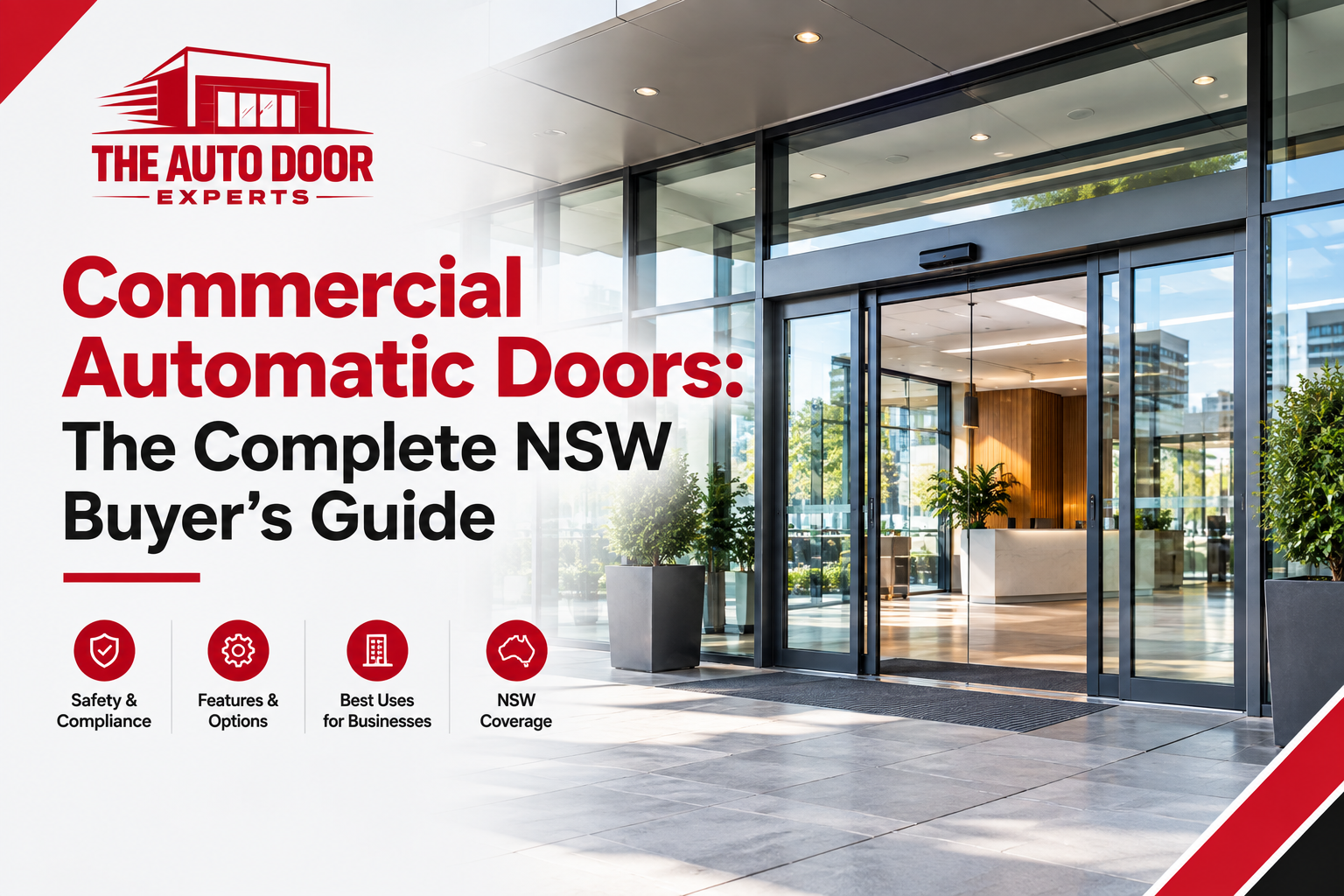
A commercial tenant managing an office fitout in Parramatta called our service desk with an honest question we hear all the time: “I’ve never bought one of these before—where do I even start?”
It is a completely understandable hurdle. Commercial automatic doors are not off-the-shelf fixtures you pick up at a hardware store on the weekend. Most facility managers, commercial landlords, and business owners only specify a powered entry system once or twice across their entire careers.
Between selecting drive mechanisms that cope with peak foot traffic, coordinating builders and electricians, and keeping on top of strict Australian safety standards, the process can feel confusing very quickly.
If you are planning a new fitout, retrofitting an aged shopfront, or replacing an entrance that constantly breaks down, this comprehensive buyer’s guide covers everything you need to know. Below, we break down door styles, compliance rules under AS 5007:2007, genuine installation costs, and how to choose an experienced team for commercial door installation across New South Wales.
What Counts as a Commercial Automatic Door?
A commercial automatic door is a high-duty, power-operated entrance engineered to endure hundreds of thousands—often millions—of opening and closing cycles under heavy daily use.
Unlike lightweight residential openers, commercial units combine heavy-duty brushless electric motors, reinforced extruded aluminium tracking, monitored safety sensors, and industrial-grade microprocessor controllers. They are designed to operate quietly, resist forced entry, and maintain climate control in demanding business environments.
Choosing the right door comes down to your building layout, available wall clearance, and pedestrian volume. The four main configurations used across Sydney commercial properties include:
1. Automatic Sliding Doors (Single-Slide and Bi-Parting)
Sliding doors are the undisputed workhorse of Australian retail shopfronts, shopping centres, healthcare hubs, and corporate foyers.
- Bi-parting sliding doors: Use two glass panels that slide in opposite directions away from the centre. They offer fast, natural two-way traffic flow and create a balanced, welcoming threshold.
- Single-slide doors: Feature a single door leaf that slides to the left or to the right. These are ideal for narrow shopfronts or corridors where side clearance exists on only one wall.
2. Automatic Swing Doors
Swing doors use heavy-duty overhead electro-hydraulic or electromechanical operators mounted directly above a conventional hinged door. They are the go-to solution for retrofitting an existing manual door frame, meeting disability access mandates under AS 1428.1, or managing controlled access points like hospital wards and commercial restrooms.
3. Automatic Telescopic Sliding Doors
When your doorway needs a wide, clear walk-through opening but has limited side-wall space, standard sliding doors hit a structural wall. Telescopic doors solve this by using two or more narrow leaves per side that slide and stack over each other into a compact footprint. They deliver roughly 30% more usable entry width than a standard sliding arrangement.
4. Revolving Doors and Specialised Industrial Entrances
Revolving doors are best suited to premium CBD office towers and high-end hotels. Because they create an airlock seal that remains open and closed at the same time, they significantly cut HVAC load by preventing wind-tunnel drafts. High-speed rapid-roll doors, by contrast, are used in industrial warehousing, cool rooms, and logistics hubs where thermal separation and rapid vehicle access take priority.
How to Match Door Mechanisms to Your Foot Traffic
The fastest way to burn out an automated entrance is to install an operator underspecified for your foot traffic. Duty cycle refers to how many times an automatic entrance opens, pauses, and closes without overheating or experiencing mechanical wear.
When planning your purchase, assess your building against three operational tiers:
- Light to Mid-Duty (Up to 500 cycles per day): Suitable for boutique offices, professional suites, and specialty consultancies. Standard commercial overhead operators handle this traffic effortlessly while maintaining reliable battery backup.
- Heavy-Duty (500 to 2,500 cycles per day): Ideal for busy suburban medical centres, educational facilities, and government service centres. These installations require continuous-duty brushless motors and heavy-duty nylon-faced carriage rollers to prevent flat-spotting.
- Extreme-Duty (2,500 to 8,000+ cycles per day): Common in major supermarkets, transport interchanges, and high-rise commercial foyers. These setups demand industrial track profiles, dual-motor drivetrains, and monitored dual-tech radar/infrared sensors that prevent door bounce during continuous foot traffic.
The 5-Stage Buying and Door Installation Process
Procuring commercial automatic doors involves careful coordination across design, engineering, and trade services. Following a clear, sequential plan ensures you avoid costly variations and on-site delays.
Stage 1: Site Inspection and Structural Audit
Before picking glass finishes or door hardware, an experienced installer must survey the opening. They will check:
- Lintel and header strength: The structural beam above the entrance must support the dynamic weight of the motor, carriage, and heavy safety glass leaves.
- Floor level and threshold fall: Commercial door bottoms use floor guides. If your finished floor level slopes by more than a few millimetres, the panels can scrape or bind along their travel path.
- Wind load exposure: Coastal properties in Sydney or exposed open-air car parks require structural jambs and glass thicknesses designed to resist flex under coastal wind pressure.
Stage 2: Drafting and Engineering Specifications
Your door contractor produces shop drawings showing clear walk-through widths, pelmet dimensions, frame profiles, and glass types. This stage confirms whether you require framed, slimline semi-framed, or frameless 12mm toughened glass leaves to match the surrounding building design.
Stage 3: Electrical Rough-In and Trade Coordination
Automatic doors do not operate in a vacuum. Your glazier, builder, and electrician must work together before the header profile goes up. Three services must be roughed in prior to installation:
- Isolated 240V mains power: A dedicated 10A power supply positioned inside or directly adjacent to the pelmet box.
- Fire trip relays: An interconnect cable linked directly to the master building fire indicator panel (FIP) so the door unlocks or opens automatically during a fire alarm.
- Access control wiring: Conduits for card readers, digital keypads, electric strike locks, or intercoms.
Stage 4: On-Site Assembly and Commissioning
Once structural frames and glazed leaves are fabricated, the installation crew secures the header, mounts the motor drive, hangs the glass carriages, and wires the safety sensors. Commissioning includes programming acceleration, deceleration, dwell times, and running diagnostic cycle tests.
Stage 5: Safety Certification and Maintenance Handover
The installer performs mandatory force testing, confirms the fail-safe emergency battery backup operates correctly, and issues a formal certificate of compliance. You should also receive maintenance logs and an initial servicing schedule.
AS 5007:2007 Compliance: What NSW Property Owners Must Know
In New South Wales, installing and operating commercial automatic doors carries clear legal responsibilities. Every powered pedestrian door installed in commercial, health, education, or retail facilities must comply strictly with AS 5007:2007 (Powered doors for pedestrian access and egress)
AS 5007:2007 exists to prevent injuries and maintain unobstructed fire evacuation paths. The primary compliance requirements include:
Kinetic Force and Impact Limits
Under the standard, a closing door leaf must not exert dangerous crushing force. Closing speeds and motor braking torque are calibrated so that if a panel strikes a pedestrian, the kinetic energy does not exceed statutory safety thresholds. The door must reverse direction smoothly within a fraction of a second.
Monitored Safety Zones
Modern commercial doors cannot rely on simple motion sensors that only detect moving people. They must feature active infrared presence curtains that constantly scan the threshold.
The controller must perform a self-diagnostic check before every single closing cycle. If the sensor fails its self-test, the door must default to a safe open position rather than closing blindly.
Emergency Evacuation and Fire Trip Systems
During an evacuation, your automatic door cannot become an obstacle. Under the National Construction Code (NCC) and AS 5007, an emergency exit door must provide safe egress through one of two methods:
- Monitored Battery Backup (Fail-Safe Open): An integrated power supply that immediately drives the doors fully open upon mains power failure or a signal from the building’s fire alarm system.
- Mechanical Breakout: Hinged door leaves that swing forward under physical push force in the direction of escape, creating a wide opening even if the drive motor is completely seized.
Six-Monthly Mandatory Maintenance
Compliance is not a one-time sign-off. AS 5007 explicitly stipulates that powered pedestrian doors must undergo preventative maintenance inspections by a competent technician at intervals not exceeding six months. Failure to log regular inspections can void commercial building insurance policies and lead to heavy liability claims if an incident occurs.
Real-World Cost Breakdown: What to Budget in NSW
Cost is always a deciding factor when planning building upgrades. The final investment for commercial door installation depends on whether you are replacing an existing drive unit or building a brand-new entrance from scratch.
Note: The figures above reflect standard Sydney metropolitan commercial projects. Final figures vary based on access, site hours, and custom architectural finishes.
Key Cost Drivers
- Glass type and frame finishes: Standard clear toughened glass costs significantly less than low-iron acoustic glass, double-glazed units, or frames finished in custom anodising or Dulux powder-coat colours.
- Access control integration: Wiring card readers, magnetic locks, intercoms, and after-hours auto-locking solenoids will add to total hardware and electrical labour costs.
- Site access and work hours: Installations inside busy shopping centres or active CBD office buildings often require after-hours work (night shifts or weekends), which incurs penalty labour rates.
Checklist: Choosing the Right NSW Commercial Door Installer
Not all contractors deliver the same level of workmanship or technical support. Use this checklist when reviewing supplier quotes to ensure you partner with an experienced specialist:
- Do they carry out on-site structural surveys? Be cautious of companies that quote solely off rough photos. An installer should inspect your floor levels, measure clearances, and check lintel capacity in person before issuing a formal price.
- Are their technicians directly employed? Companies using direct, factory-trained technicians typically deliver higher installation quality and faster accountability than those relying entirely on subcontracted labour.
- Do they calibrate to AS 5007 with digital force gauges? Ask how they test safety limits. A qualified contractor uses digital gauges to verify kinetic impact limits rather than simply guessing closing speeds by hand.
- Are replacement spare parts kept in stock locally? Ask where their replacement parts come from. If an operator relies on obscure overseas components with six-week international shipping times, a minor mechanical breakdown could leave your business entrance inoperable for weeks.
- Do they offer 24/7 emergency repair services? Automatic doors break down outside regular business hours. Your provider should offer direct emergency repair support across Greater Sydney to keep your premises secure.
Frequently Asked Questions
How long does a commercial automatic door installation take?
For a retrofit where new tracking and an operator are fitted to an existing structural opening, on-site work is usually completed in a single working day. For a complete new entrance involving custom framing, fabricated safety glass, and electrical rough-in, the typical manufacturing lead time runs between 2 and 4 weeks, followed by 1 to 2 days of on-site installation and commissioning.
Can an existing manual door be converted to automatic?
Yes. If the existing door panel and surrounding frame are structurally sound, an overhead automatic swing door operator can be mounted to the transom. The technician runs power to the unit, installs push plates or radar sensors, and connects electric locking hardware. This is a practical, cost-effective way to achieve AS 1428.1 disability access compliance.
What happens if the power goes out?
Commercial automatic doors feature an uninterruptible power supply (UPS) battery backup. In the event of a mains power failure, the battery takes over, allowing the door to continue operating normally for several cycles before holding open to preserve an emergency exit path, in accordance with AS 5007.
How often do commercial automatic doors require maintenance?
Under Australian Standard AS 5007:2007, commercial powered doors must be serviced by a qualified technician at least once every six months. Regular servicing keeps carriage rollers, belts, and drive motors running smoothly while ensuring presence sensors and fail-safe safety batteries function properly.
What safety sensors are required on commercial doors?
Modern installations require dual-technology sensors. These combine microwave Doppler radar to detect walking traffic as people approach, alongside active infrared light curtains that scan the threshold. The infrared curtain stays active while people, prams, or mobility aids remain inside the doorway, preventing the door from closing unexpectedly.
Build a Secure, Reliable Commercial Entrance
Your entrance is the first practical touchpoint for every customer, client, and employee visiting your property. Investing in the right commercial automatic doors protects your building’s climate control, ensures seamless accessibility, and keeps your facility fully compliant with Australian safety laws.
Taking the time to survey your opening, calculate daily cycle volumes, and partner with an experienced installer prevents expensive rework and keeps your doors running smoothly year after year.
The team at The Auto Door Experts delivers custom design, professional commercial door installation, and certified AS 5007 maintenance solutions across Sydney, Parramatta, Wollongong, and regional NSW.
Ready to plan your new commercial entrance?
Call 1300 829 998 or request an on-site design consultation and free quote today.