
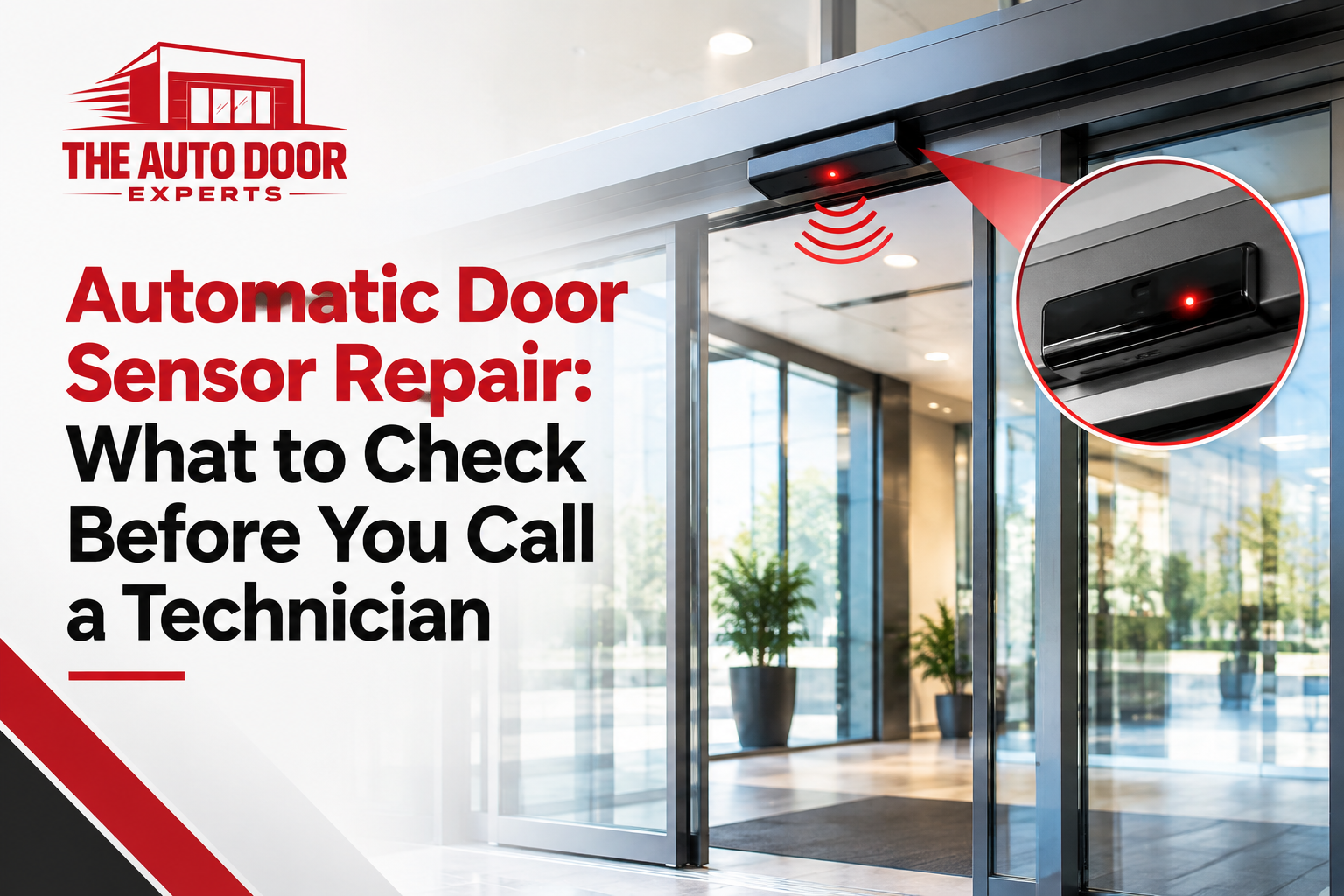
A commercial building manager in North Sydney rang our dispatch team early last Tuesday in a proper bind. It was 7:45 AM, staff were arriving, and the main foyer’s automated glass sliding doors were frozen shut.
She was understandably stressed. Her immediate assumption was that the motor had burned out, the drive belt had snapped, or the master logic board had fried overnight. In her mind, she was already budgeting for a multi-thousand-dollar emergency replacement.
When our technician arrived twenty minutes later, the actual culprit took roughly thirty seconds to spot. A thick crust of windblown road grime, diesel soot from the bus route outside, and a stubborn spiderweb had completely coated the optical sensor’s curved acrylic housing.
Five minutes, a clean ladder, and a dry microfibre cloth later, the safety beams cleared, the cycle engaged, and the doors glided open like new. No replacement parts. No multi-thousand-dollar overhaul. Just a standard service check.
When an automatic door’s “eyes” fail, the symptoms look catastrophic. The doors will either refuse to budge, bounce back open repeatedly, or freeze wide open to let the rain and winter draft straight into your reception area. In reality, commercial sensors are sensitive, highly tuned detection instruments that throw false positives over everyday environmental dust.
Before paying an emergency call-out fee, run through what is happening inside the sensor head, what safe checks you can conduct yourself, and where the legal and technical boundaries lie for DIY fixes.
How Automatic Door Sensors Actually “See”
To troubleshoot a sensor, it helps to understand what kind of technology is watching your doorway. Most modern commercial properties across Australia use one of three core sensor styles—or an integrated unit that combines two of them into a single housing.
Radar (Microwave Motion Sensors)
Microwave sensors act like tiny speed radars. They emit high-frequency radio waves across your entryway and monitor how quickly those waves bounce back.
When a person walks toward the door, the returning wavelength shifts (the Doppler effect), telling the controller someone is approaching. The catch? Radar only cares about movement. The moment a person stops walking and stands dead still in the frame, a pure radar sensor cannot see them.
Active Infrared Presence Sensors (AIR)
Infrared units are your safety net. They bounce invisible spots or curtains of optical light straight down onto the floor threshold.
The sensor continually records the distance to the floor tiles. If a pedestrian, a mobility scooter, or a toddler steps into that light curtain, the bounce-back distance changes instantly. The sensor registers an obstruction and prevents the door leaves from sliding shut.
Combined Dual-Technology Units
Most contemporary Sydney office towers, medical clinics, and supermarkets use combined units mounted centrally on the transom or pelmet. These pack a radar motion detector and an infrared presence curtain into a single slimline plastic casing.
If either half of that module gets blocked, blinded, or misaligned, the whole door operator goes into fail-safe mode.
4 Common Reasons Sensors Stop Responding
Commercial sensors cycle thousands of times a week while dealing with external elements. When they drop offline, the cause usually falls into one of four buckets:
1. Optical Contamination and Smudging
Unlike indoor security alarms, commercial entrance sensors sit directly exposed to Sydney’s atmospheric quirks. Coastal salt air, diesel particulate from passing traffic, construction dust, and tree pollen adhere to the sensor’s curved plastic face.
Spiders also love the warmth given off by the sensor’s internal circuit board. A tiny web spun across the infrared emitter will scatter the light beam, tricking the door logic into thinking a person is permanently standing in the entrance.
2. Physical Misalignment from Minor Knocks
Sensors are mounted on or just above the door’s structural frame. Cleaners bumping an extendable pole, couriers navigating oversized handcarts, or building movement during heavy wind gusts can nudge the sensor bracket by just three or four millimetres.
That tiny shift can throw the infrared safety curtain straight into the path of the sliding glass leaf itself. When the door starts to close, the sensor spots the moving glass edge, panics, and bounces open again on an endless loop.
3. Threshold Clutter and Environmental Drift
Because presence sensors map the floor surface directly below the door, sudden changes to that floor surface confuse the unit.
A high-contrast floor mat shifted out of position, bright sunlight reflecting off polished terrazzo, or seasonal decorations hung from the pelmet can bounce light back at erratic angles, holding the doors open indefinitely.
4. Component Fatigue and Internal Electronics
Commercial automated doors take a hammering. Over five to ten years of heavy operation, internal electronic components degrade.
Infrared emitter diodes lose luminous output, wiring inside the pelmet vibrates loose from thousands of continuous cycles, or stormwater leaks past the facade seals and corrodes the controller terminals.
The 3-Step Safety Checklist Before You Call a Pro
You do not need an electrical licence or an engineering degree to perform basic, non-invasive maintenance checks. If your doors are acting up, carry out these three simple steps first.
Step 1: Clean the Sensor Lens (The Right Way)
Look at the sensor mounted on the pelmet above the door line on both the inside and outside of the opening.
- What to do: Take a clean, dry, lint-free microfibre cloth and gently wipe the entire curved plastic lens, clearing away dust, insect casings, and grime.
- What NOT to do: Never spray glass cleaner, methylated spirits, degreaser, or aerosol surface spray onto the unit. Solvents strip the anti-glare coating and cause micro-cracking (crazing) across optical acrylic. That permanent hazing will blind the sensor permanently, turning a five-minute wipe-down into a complete sensor replacement.
Step 2: Scan the Peripheral “Ghost” Zone
Sensory fields often extend wider than the door opening itself to catch people approaching from an angle. Look down and around the perimeter for items that may have been placed there recently.
- Check for sandwich boards and A-frames: Cafe and retail operators frequently push advertising boards too close to the automated threshold.
- Check for temporary displays and deliveries: Courier boxes dropped in the corner, umbrella stands, or seasonal floral arrangements can sit on the boundary of an infrared beam.
- Check for draft-induced movement: Loose plastic hanging strips, overhead promotional banners, or leafy plants swaying in a strong gust can continuously trigger microwave motion detectors.
Step 3: Visually Inspect the Housing and Indicator LEDs
Stand safely to the side and look closely at the sensor housing.
- Is the casing square? Check whether the outer cover has popped loose from its clips, or if the unit looks crooked after an impact with a ladder or trolley.
- Observe the LED indicator light: Almost every modern sensor (such as those made by BEA, Optex, or Hotron) features a diagnostic LED light visible through the translucent lens.
- Solid Green: Sensor is powered, healthy, and idling normally.
- Solid Red or Amber: Detection zone is triggered (if no one is standing there, the sensor is “seeing” an obstruction or its own frame).
- Flashing Red/Orange: The unit has detected an internal optical failure, a power supply drop, or a failed self-test cycle.
If the LED is flashing an error code or staying solid red on an empty doorway after cleaning, the problem is no longer superficial.
When to Stop: The Line Between DIY and Illegal Electrical Work
It is tempting for a handy facility manager or site caretaker to grab a screwdriver, pop off the pelmet cover, and start tweaking internal potentiometer dials.
Do not do this.
There is a clear operational, safety, and legal boundary between wiping down an exposed lens and modifying automated door mechanisms.
AS 5007 Regulatory Compliance in Australia
In Australia, pedestrian automatic doors are regulated under AS 5007 (Powered doors for pedestrian access and egress). This standard does not just dictate how fast a door opens—it sets mandatory requirements for user safety, fail-safe modes, and emergency egress.
Automatic door sensors are not convenience gadgets; they are life-safety components. Under AS 5007:
- The infrared presence curtain must cover a specific, calibrated hazard zone across the closing edge of the door panels.
- The system must detect stationary test bodies (representing a fallen pedestrian, a small child, or someone using a walking frame) for a defined period before closing.
- If main power drops, the door must either spring-open or battery-open to clear the fire egress route.
If an untrained worker adjusts an internal sensitivity pot or alters dip-switch settings without calibrated test dummies and optical light meters, that safety curtain can easily be shifted out of compliance.
If that door later closes on an elderly resident, an infant in a pram, or an office worker, the building owner and manager face severe public liability, insurance invalidation, and WorkCover penalties.
If your sensor is showing a fast blinking red or orange light, wiping the cover is worth a shot. If that fails to clear the pattern, the unit has failed its internal health check and requires replacement or specialist bench testing.
What a Professional Repair Involves (And Expected Costs)
When you call a certified automatic door technician, you aren’t paying someone to simply wipe a cover. Professional diagnostics involve calibrated testing to identify the root cause without guesswork.
1. Electrical Continuity and Signal Checks
A technician uses a multimeter to verify that the power feed arriving from the door’s master logic module (typically 12V to 24V AC/DC) is steady. Drops in voltage will cause sensors to cycle erratically or drop into safety-lockout mode.
Technicians also test the monitoring circuit—a dedicated feedback loop required by modern safety standards that forces the sensor to prove it is functional before allowing the drive motor to close the doors.
2. Optical Alignment and Pattern Masking
Using specialised infrared optical detector sheets, the technician maps the invisible light pattern cast onto your floor.
Using internal mechanical adjustments (not external bending), they adjust the tilt angle from -4° to +4° and apply physical shutters or digital masking to prevent the sensor from reading the moving edge of the glass doors or nearby metal window frames.
3. Cycle Force and Entrapment Testing
Technicians carry calibrated test bodies matching AS 5007 specifications. They position these targets directly in the path of the closing door to confirm the infrared field picks them up reliably across the entire threshold, stopping and reversing the door panels before they exert dangerous pinch pressure.
Cost Expectations
- Basic Service Call & Recalibration: If the sensor simply requires professional realigning, dip-switch reconfiguration, and terminal cleaning, the job is typically wrapped up within a standard 1-hour service call-out fee (usually between $180 and $320 + GST, depending on location and after-hours timing).
- Sensor Module Replacement: If the sensor’s internal optical diodes are exhausted or water damage has burned the circuit, a brand-new commercial-grade combined radar/infrared sensor (from premium manufacturers like Optex, BEA, or Record) typically ranges between $350 and $650 + GST for the hardware, plus installation and compliance calibration.
Practical Preventative Maintenance for Facility Teams
You can prevent 80% of sensor failures by adding two minor steps to your cleaning team’s regular roster.
- Fortnightly Dusting: Include the external sensor faces in your cleaners’ routine. A fast, dry microfibre pass removes salt and dust buildup before it bakes on or settles into optical seams.
- Clear-Zone Enforcement: Instruct staff and retail tenants never to stack promotional boxes, place umbrella bins, or park pushbikes within 1.5 metres of the entrance glass.
- Periodic Pest Checks: Have pest control pay close attention to transom headers and pelmet housings. Cockroaches, geckos, and spiders routinely nest inside warm electrical boxes, causing short circuits that take down the entire automated entrance.
Frequently Asked Questions
Can I spray window cleaner on my door sensor to clean it?
No. Standard window cleaners contain ammonia, alcohol, or other harsh solvents that can cloud or degrade the polycarbonate lens. This ruins the sensor’s optical clarity, preventing it from accurately reading the infrared light curtain and potentially requiring an early replacement. Stick exclusively to a clean, dry microfibre cloth.
Why does my sensor work during the day but fail at night?
This usually points to one of two issues: temperature drops or artificial lighting. Cheaper or aged infrared sensors can struggle with thermal drift as temperatures drop after dark, causing older electronic components to fall out of spec. Alternatively, if nearby security floodlights switch on at dusk, direct, unshielded light can shine straight into the optical receiver, blinding the sensor.
How long does a commercial automatic door sensor typically last?
In an average commercial environment with typical foot traffic, high-quality sensors from reputable manufacturers generally run trouble-free for 7 to 10 years. In high-exposure settings—such as beachfront properties exposed to salt air, or bus interchanges heavy with diesel particulate—lifespans can drop to 3 to 5 years without routine maintenance.
Is an intermittent door sensor considered an emergency?
Yes. If a sensor works intermittently, it means the safety presence barrier is unreliable. A door that closes unexpectedly risks striking staff, customers, or visitors, leaving your business open to significant public liability claims. If the door cannot be locked open safely, call a technician promptly to prevent injuries.
Can high winds affect my automatic door sensors?
Wind itself does not trip infrared or microwave sensors directly. However, strong drafts can cause external blinds, hanging display signage, or nearby trees to whip into the sensor’s detection field. Severe gusts can also cause unreinforced, tall glass panels to bow slightly in their tracks; if the sensor curtain is set too close to the glass, this slight movement can trigger a continuous open-and-close cycle.