
Introduction
A client asked us last month whether their new pharmacy fitout needed a “touchless door” or a “sensor door” — and then followed up with, “aren’t those the same thing?” It’s a fair question, and honestly, one we get a lot. The two terms get thrown around interchangeably by suppliers, builders, and even some door installers, which makes it genuinely confusing when you’re trying to spec the right entrance for your business. The truth is there’s a real technical difference between them, and getting it right matters more than most people realise — it affects your upfront cost, your compliance position, and, in some industries, how safe your customers actually feel walking through your front door.
Here’s the plain-English breakdown.
What Is a Motion Sensor Door?
A motion sensor door is an automatic door that opens when it detects movement or a person’s presence nearby. A sensor mounted above or beside the door — usually microwave, infrared, or a combination of both — picks up motion within a set detection zone and signals the door operator to open.
This is the standard technology behind the majority of automatic door systems installed across Sydney retail stores, shopping centres, and office lobbies. It’s reliable, well-understood, cost-effective, and has been the industry default for decades.
Key characteristics of motion sensor doors:
- Detect approaching movement, not physical contact
- Standard on most automatic sliding and swing doors
- Widely available, cost-effective to install and maintain
- Suitable for general retail, office, and public-access entrances
What Is a Touchless Door?
A touchless door is a broader term describing any entry system specifically engineered to remove the need for physical contact at any point — not just at the main entrance, but often at interior doors, exit points, and access-control switches too.
Touchless systems can use motion sensors (like above), but they also often include:
- Wave-to-open or proximity sensors at push-button locations
- No-touch exit switches for internal doors
- Hands-free activation zones designed specifically around hygiene, not just convenience
This is where the real distinction lives: a motion sensor door opens automatically, but a touchless door is designed around the specific goal of eliminating hand contact everywhere it reasonably can.
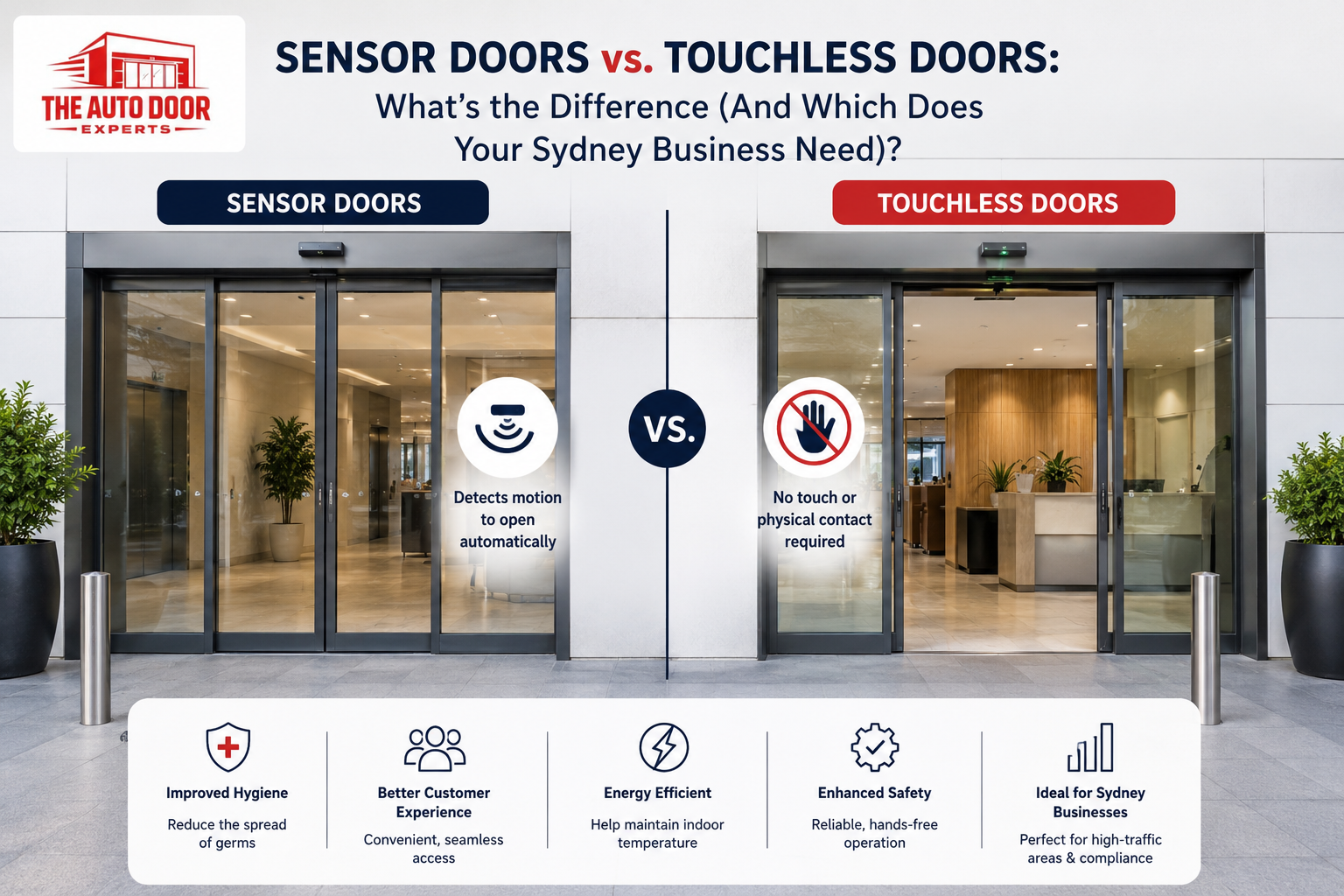
Sensor Doors vs. Touchless Doors: The Actual Difference
Here’s the simplest way to think about it:
All touchless doors use sensors. Not all sensor doors are built or marketed as “touchless.”
A standard motion sensor door at a retail shopfront does the job it needs to do — open reliably when someone approaches. But it’s typically designed for throughput and cost-efficiency, not specifically for hygiene. A touchless system is a more deliberate, often more comprehensive approach: sensors at the main entrance, no-touch switches at internal doors, and sometimes extended detection zones to reduce any need to slow down or reach for a handle at all.
| Motion Sensor Door | Touchless Door | |
| Primary purpose | Convenience, automatic access | Hygiene, contact elimination |
| Typical locations | Retail, office, shopping centres | Healthcare, aged care, hospitality, food service |
| Scope | Main entrance activation | Entrances + internal doors + exit switches |
| Relative cost | Standard | Slightly higher, due to added touchless components |
Which One Does Your Business Actually Need?
This is the part that actually matters, so here’s the direct answer:
Choose standard sensor doors if:
- Your entrance is public-facing, high-traffic, and hygiene isn’t a primary driver
- You’re running a general retail store, office, or showroom
- Cost-efficiency and reliability are the priority
Choose touchless doors if:
- You operate in healthcare, aged care, hospitality, or food service
- Hygiene compliance or perception is important to your customers or regulators
- You want automatic activation extended to internal doors, not just your main entrance
- Accessibility for elderly or mobility-impaired visitors is a priority alongside hygiene
For most Sydney retail and office entrances, a well-installed motion sensor door does exactly what’s needed. For medical centres, pharmacies, aged care facilities, and hospitality venues, the small additional investment in a genuinely touchless door system tends to pay for itself in compliance confidence and customer trust.
Frequently Asked Questions
Is a touchless door more expensive than a sensor door? Usually, yes — but only slightly. The added cost comes from extra touchless components like no-touch exit switches or wave sensors at internal doors, not from the main automatic door operator itself.
Can an existing sensor door be upgraded to touchless? In many cases, yes. If the existing automatic door system and operator are in good condition, it’s often possible to retrofit touchless activation components rather than replacing the whole system.
Do touchless doors need more maintenance than standard sensor doors? Not significantly. Both rely on sensor technology that needs periodic calibration and cleaning — a touchless system simply has a few more components to check during a routine service.
Are touchless doors required by law in Australia? No specific Australian law mandates touchless doors, but automatic doors (sensor or touchless) do need to comply with AS5007, the Australian Standard for Powered Doors, particularly around safety, detection, and accessibility.
Not Sure Which System Fits Your Entrance?
Every site is a little different, and the right answer often comes down to details a blog post can’t cover — your existing door frame, foot traffic patterns, and industry compliance requirements. If you’re planning a new installation or upgrading an existing automatic door, it’s worth getting a second opinion before you commit either way.
The Auto Door Experts can assess your entrance and recommend the right sensor or touchless configuration for your industry — no pressure, no guesswork. Call 1300 829 998 for a free site inspection, or get in touch online.